

Emily Lau
Staff Writer
Faculty and staff members of the University of La Verne discussed the effects a militarized mindset have on the police at a panel titled “The Social Context in Which Law Enforcement Operates: Militarization of Police and Race Relations in Law Enforcement Encounters,” the third part of the five-part series “Ferguson: A Call for Understanding and Action,” Thursday at the La Verne College of Law.
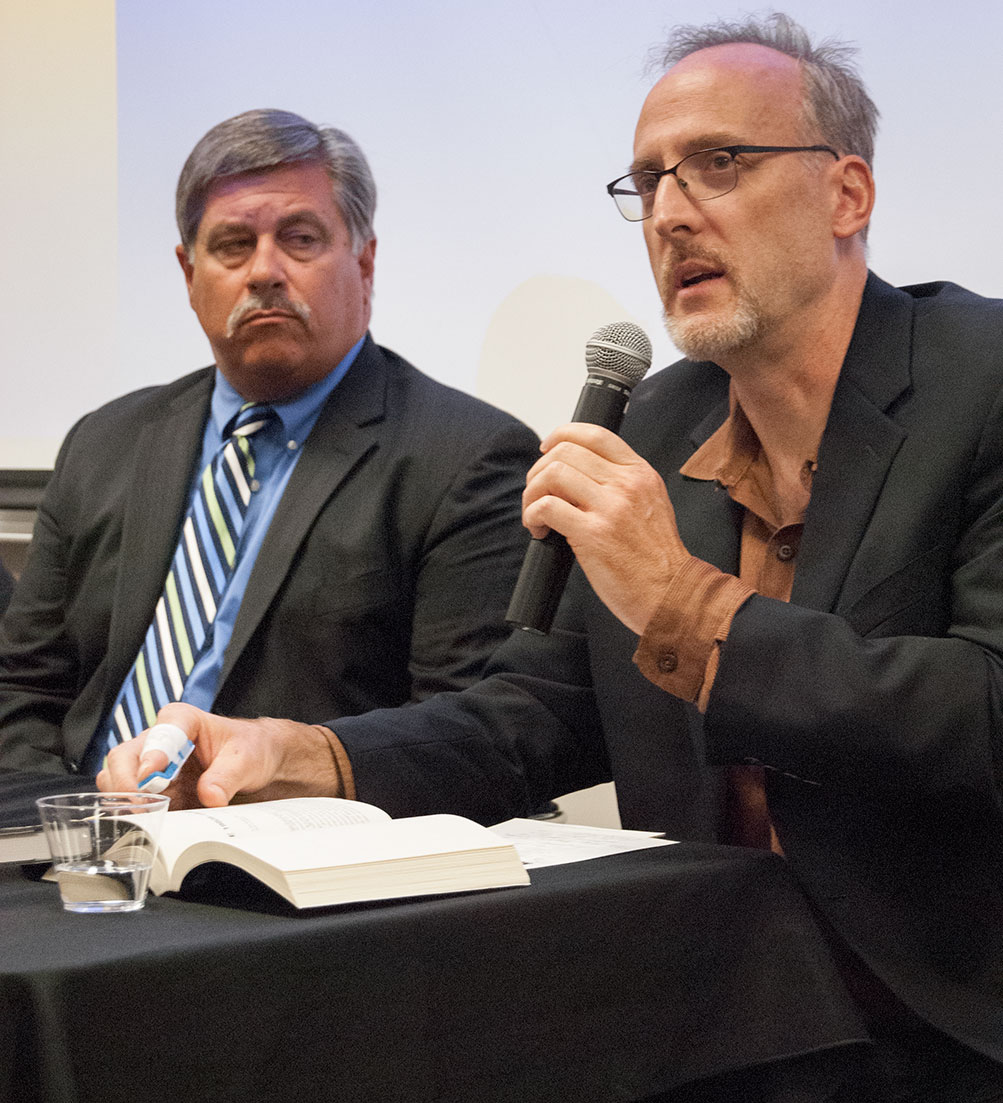
The panelists were Isaac Carter, director of student affairs at the College of Law; Stanley Skipworth, senior director of campus safety and transportation; and Matthew Witt, professor of public administration. Visiting Assistant Professor of Law Michael O’Connor moderated the panel. Law School Dean Gilbert Holmes provided an introduction and recap of the previous panels.
O’Connor followed with a video clip from “The Wire,” a crime drama television show set in Baltimore. The clip involved a conversation between a major and police sergeant as they reflected upon the modern day police force.
“We hear a lot about militarization and it’s usually discussed in terms of hardware – tanks, armored personnel carriers, helicopters, body armor and assault weapons,” O’Connor said.
“The clip we just saw discussed not hardware but a shift in mentality from policing to combat,” he said.
All three panelists agreed to an extent that such a mindset and other factors such as race have had impacts on how police forces interact with their communities.
“I think that mentality can be described as, from a protective state of a police department to one of a predatory state, to try to keep the control of society by controlling the population in where people can mobilize and move freely,” Carter said.
The panel moved on to a discussion about the impact of using military hardware in police forces.
Skipworth, a former police chief for Cal State Long Beach, has had personal experience with training and working with police forces.
He recalled the differences in today’s police force and described how many police officers wear thicker ballistic vests on the outside of the clothes as opposed to inside.
“I think that a lot of the more frequent appearances in just the traditional police officer who is assigned to go out and patrol – that look has changed significantly,” Skipworth said. “They look even larger, they look more imposing and I think that part of that feeds into their mindset, if you will, about how they’re going to go out and do their jobs.”
The topic then shifted to what the panelists thought about race and how it influences police forces and the community.
Witt said based on research and data, he believes that race has a profound effect.
“Particularly black communities in the United States have been beset upon by congress of sorrows like no other experience in the United States and these were not choices made by people of color,” Witt said. “These were choices determined, predetermined.”
Carter, who is African-American, shared his own personal account about growing up in St. Louis, when a police officer told him to go back into his house because of curfew despite being on his porch.
“There has always been an antagonistic relationship,” Carter said.
“There has never been a police officer like, ‘How’s school going?’ or asking about your family. It’s about profiling, stops and ‘I know you have a friend that sells drugs. Are you selling drugs too?’” he said.
The panel ended with a question and answer session that expanded the discussion of militarization of police forces to more local issues, including the Los Angeles Unified School District possessing grenade launchers and a tank and the possibility of equipping the University campus security with batons and pepper spray.
Regarding campus security acquiring new equipment, Skipworth said the subject has been discussed for the sole purpose as a protective option.
The fourth part of the series, “Community Justice: Community-based Alternatives to Traditional Law Enforcement,” will be held Nov. 18.
Emily Lau can be reached at emily.lau@laverne.edu.


