

Sarah Veissalov
Staff Writer
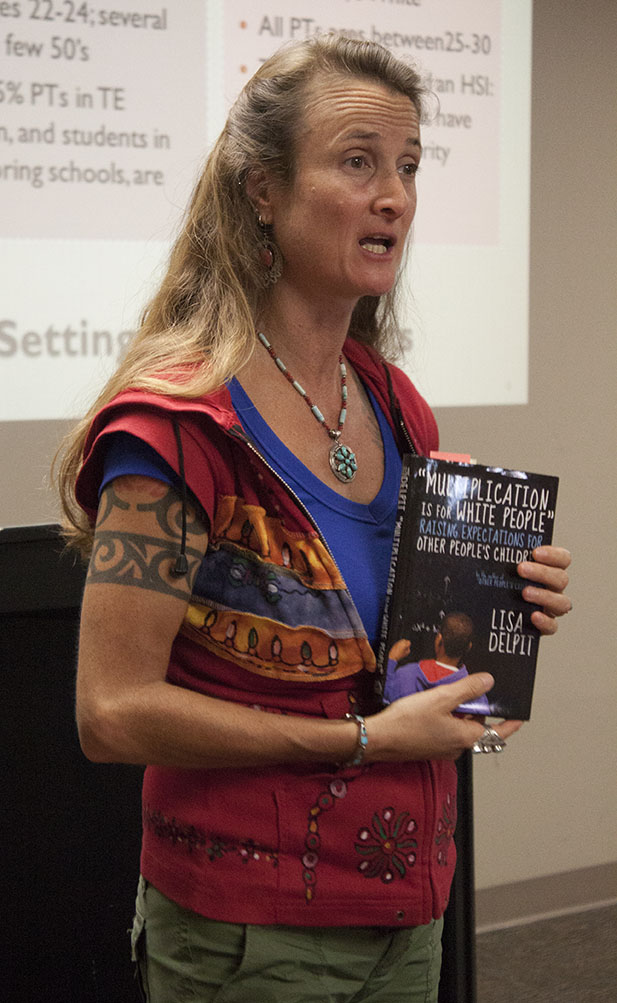
The faculty lecture series on Monday featured Marga Madhuri, associate professor of education, who presented “Preservice Teacher Dispositions to Using Social Justice Literature in Remote Suburban and Metropolitan Teacher Education Programs.”
About a dozen people attended the faculty lecture at noon in the President’s Dining Room to hear Madhuri discuss how she and her colleague, Keonghee Tao Han from the University of Wyoming, developed their teaching project.
The project covered the differences of teaching in separate states and gathering information on how ethnically diverse – and non-diverse – locations affect the students.
“We are surrounded by a diverse type of population whereas Wyoming is different,” Madhuri said.
Madhuri described the remote suburban area as people being all the same and believing in the same.
“Our world is shaped by where we came from, what we did, and where we grew up,” Madhuri said.
Madhuri, who grew up in Michigan, related this diversity teaching to her life and how she was raised in a Jewish family.
“It is a lovely religion, but hard to practice here,” Madhuri said. “It is hard to be Jewish in a Christian society.
“Who knows where you’ll end up,” Madhuri said. “Just because you’re here doesn’t mean you will stay.”
Tao Han taught two semesters in Wyoming and Madhuri taught one semester of students in California.
At the end of teaching, they compared their research.
In Madhuri’s presentation, she discussed different themes for the remote suburban area and the metropolitan urban area that was noticed from teaching their classes.
The theme for the remote suburban area was that students had little exposure and understanding of racial diversity.
For the metropolitan suburban area, the theme was that the students had a superficial understanding of social justice.
When they compared the research they gathered, Madhuri noticed that her students expected to work with diverse cultures because of how common it is to them.
Some students felt they needed to learn more now that the course had ended.
As the presentation came to an end, Madhuri discussed practical recommendations for some issues, which included using diverse curricular materials, using multicultural or multimodal materials and providing multicultural settings for fieldwork experiences.
Brooke Hines, sophomore child development major, related much of what she heard in the lecture to her honor’s class and child development courses.
“My classes are always teaching us to be aware of our surroundings and environment,” Hines said.
Marcia Godwin, associate professor of public administration, said the lecture raised a lot of questions about teacher education and prospective teachers view of students.
It also provided self-awareness.
“There are a lot of different dimensions to diversity,” Godwin said.
“People come into a program with a different level of thinking,” she added.
Because her family lives in Eastern Oregon and she moved to Oxnard, Godwin said that she thought what was presented in the lecture related to her own experience.
“It is practical because it relates to how teacher education programs change over time,” Godwin said.
Sarah Veissalov can be reached at sarah.veissalov@laverne.edu.

